NEDOプロジェクト
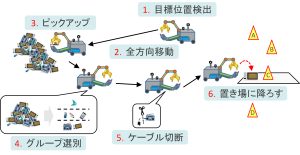
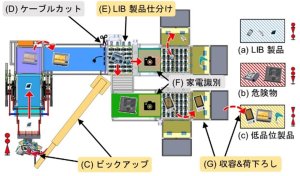
NEDOの委託事業「高度循環型システム構築に向けた廃電気・電子機器処理プロセス基盤技術開発」での研究開発項目①「資源循環性高度化プロセス技術開発」―(1)製品解体・分解システム開発での1課題として,「小型家電ヤード自律選別システム」に取り組んでいる.具体的には,リサイクル工場の屋外にある小型家電ストックヤードから危険物等(油・可燃性ガス・リチウムイオン電池(LIB)利用製品等)を仕分けする自律選別システムを開発する(図1).そのために,(1)目標位置検出システム開発チーム,(2)全方向移動車輛開発・制御チーム,(3)小型家電ピックアップ機構開発チーム,(4)小型家電識別・分類システム開発チーム,(5)電源ケーブルカット機構開発チームを編成し,チームごとに試作を進めている.
Within the NEDO’s commissioned project “Development of Fundamental Technologies for Processing Waste Electrical and Electronic Equipment toward Advanced Recycling System,” we are working on a research topic titled “Development of Advanced Resource Recycling Process Technologies – (1) Development of Product Disassembly System.” Specifically, we are tackling the challenge of developing an autonomous sorting system that segregates hazardous materials (such as oil, flammable gases, and lithium-ion battery-powered devices) from the stockyard of small home electronics located outside the recycling plant (Fig. 1). For this purpose, we have organized small teams for development task: (1) a target location detection system, (2) an omnidirectional vehicle development and control system, (3) a small appliance pickup mechanism, (4) a small appliance identification and classification system, and (5) a power cable cutting mechanism.
バイナリー発電プロジェクト
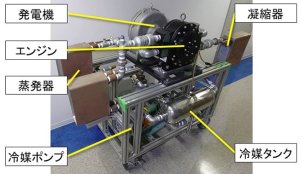
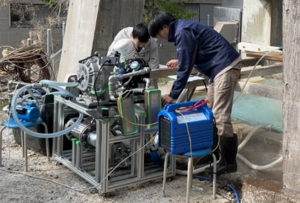
地熱発電は,CO2の排出量がほぼゼロの極めて環境適合性に優れたベースロード電源である.特に日本は,世界第3位の地熱資源量(約2,347万kW)を誇っており,非常に高い利用可能性を有している.一方,地熱発電の主流であるフラッシュ発電方式には高温熱源が必要であり,新規開発できる土地が限られていることから,現状の地熱発電は国内発電量の0.3%に留まっている.そこで小林研究室では,10 kWの発電量を目標に,中・低温熱源を利用した小型バイナリー発電装置の開発に取り組んでいる.現在,装置のパラメータ調整や改良を行うと共に,試作機を用いた実地実験により性能評価を行っている.なお,昨年度末には,複数の部門メンバーで静岡県の伊豆 熱川で行われた実地実験の見学も行っている.
Geothermal energy is an environmentally friendly baseload power source with nearly zero CO₂ emissions. Japan ranks third globally in geothermal resources (~23.47 million kW), offering high potential for utilization. However, mainstream flash power systems require high-temperature sources, which limits development locations. Currently, geothermal accounts for only 0.3% of domestic power generation. To address this, Prof. Kobayashi’s lab is developing a compact binary power generation system utilizing medium- to low-temperature sources, with a target output of 10 kW. The team is adjusting system parameters, conducting upgrades, and evaluating performance through on-site experiments. At the end of the previous fiscal year, a group site visit was held at the Atagawa hot springs in Izu, Shizuoka Prefecture, where the system was demonstrated.
リビングラボプロジェクト
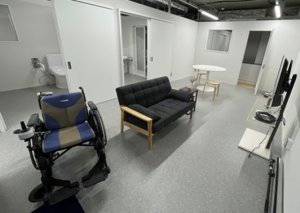
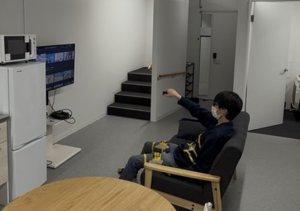
機能デザイン工学科に所属するメンバーを中心として,同学科に設置されているリビングラボを活用した研究を行っている.リビングラボには,居間,寝室,キッチン,トイレ,洗面,入浴など,人間が生活するために必要な住居設備が備えてあり,生活空間の外側にはマジックミラーを介した観察スペースが設けられているため,生活空間での人の行動に影響を与えることなく観察や見学が可能となっている.また,バリアフリー化も行われており,車椅子や自律型の生活支援ロボットが移動し易いようになっている.さらに,人やロボットの運動を計測るためのモーションキャプチャを設置できるようになっている.現在,複数教員が参画する分野横断研究として,支援ロボット・福祉用具の設計指標の検討,それらの効果検証や評価,標準化研究を行っている.
Centered around members of the Department of Medical and Robotic Engineering Design, this project utilizes the Living Lab—a facility equipped with residential features such as a living room, bedroom, kitchen, toilet, washroom, and bath. Observation spaces behind one-way mirrors allow unobtrusive study of human activity. The space is barrier-free and designed for easy movement of wheelchairs and autonomous assistive robots. It also supports motion capture systems. Ongoing cross-disciplinary research includes: design guidelines for assistive robots and welfare devices, evaluation and verification of their effects, and standardization efforts for broader adoption.